
Mining activities involve extracting or storing substances into or from the subsurface. This alters the original composition of rocks or fluids in the subsurface, which would otherwise change only slowly over geological timescale. Even after operations have ceased, fluid migration can continue in and around reservoirs, so this should be anticipated. Mining facilities can also pose environmental hazards and risks, such as leaks from wells, pipelines or processing plants. Mining authorities must approve operators' extraction or storage plans before mining activities can begin.
KEM research focuses on improving the monitoring and understanding of, and the ability to quantify and predict, the origin of mining-related environmental effects (source), the migration of unwanted substances to the surface (path), the resulting hazards, and the impact on the built environment, people, and the environment (impact).
More ...
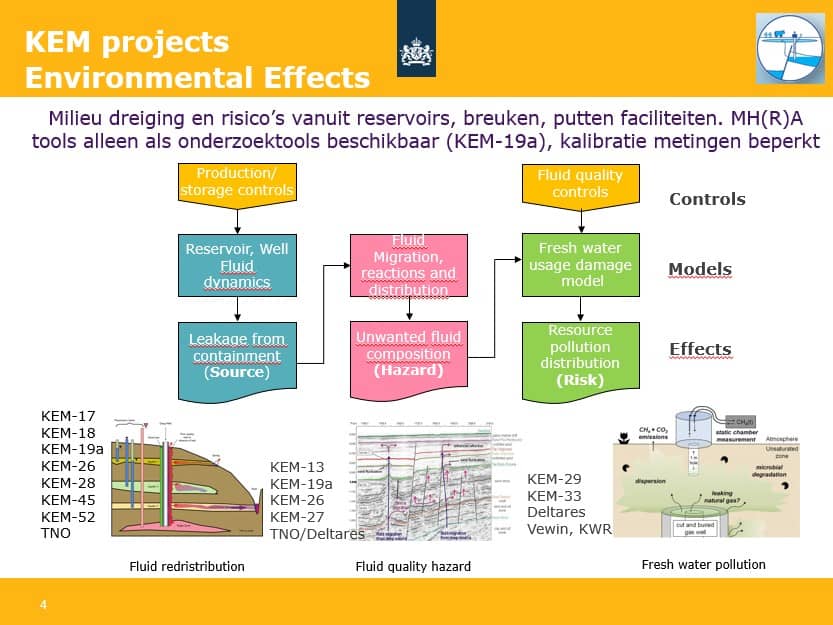
Image: © KEM / KEM
Focus of KEM projects on Environmental Effects
A limited number of KEM projects concern environmental risks. These projects aim at developing better scientific insights for better subsidence hazard and risk assessment instruments and risk management practices.
In figure at the bottom of this page, KEM research (project numbers) can be found and their focus on, being source, path or impact, of subsidence risks.
The research questions, project deliverables and the evaluation of each finished project can be found under KEM projects. The research questions not (yet) addresed can be found under KEM research questions.
There are generally applicable and publicly available reservoir and hydrogeological models for analysing fluid flow. Specific environmental damage and safety risks tools exist to some extent, but are only used to a limited extent to assess the effects of fluid migration after the end of mining operations.
Risk models and risk-based design protocols are available for drilling, wells, installations and pipelines; management of operational fluid pressure risks is common practice. However, there are only a limited number of models publicly available or prescribed that can be used to assess or predict the integrity of mining infrastructure during construction, operation and abandonment. Expert judgement and studies are common practice here.
Leakage monitoring from facilities is standard practice for operators, including incident alerting and reporting.
There is limited guidance available for environmental monitoring of fluid migration from reservoirs or caverns.
There are developments ongoing in long-term environmentally monitoring of wells, as ca be concluded from SodM messages..
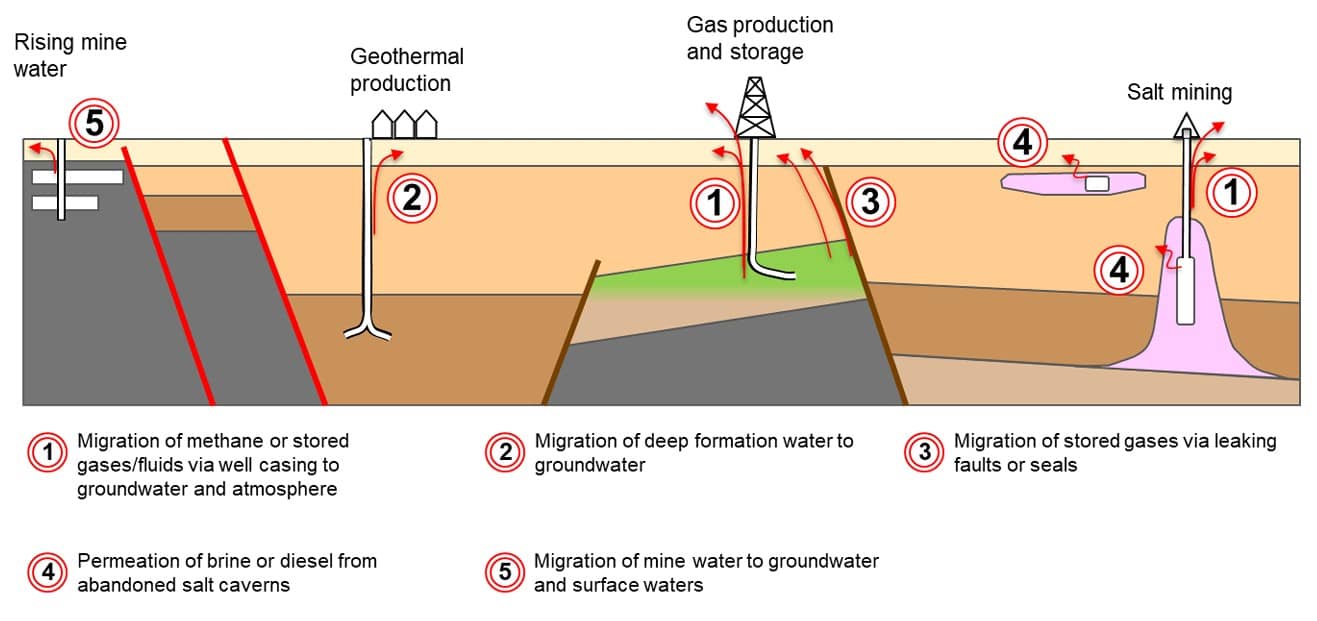
Image: © KEM / TNO
Schematic figure of potential environmental effects of mining