
Both natural tectonic and human-induced earthquakes occur in the Netherlands, causing ground shaking at the surface. Other man-induced vibrations, mainly caused by building or transport activities, may also occur.
KEM focuses on improving the monitoring and understanding of earthquakes genesis (source), the propagation of vibrations and the resulting hazard at the surface (path), and the impact on the built environment, people and the environment (impact).
More ...
Image: © KEM / KEM
Focus of KEM projects on Seismicity Groningen gas field
Many KEM projects deal with seismic hazards and risks. KEM projects focus on developing scientific insights for the development and improvement of instruments to determine threats and risks and the effect of control measures.
The two figures at the bottom of this page show the KEM project numbers and their focus on the source, path, or impact of seismic ground movements. The first figure shows seismic research into the Groningen gas field and the second into other mining activities.
The research questions, project results, and evaluation of each completed project can be found under KEM projects. The research questions that have not (yet) been addressed can be found under KEM research questions.
For the Groningen gas field, NAM and its partners have developed between 2025-2020, an advanced probabilistic seismic hazard and damage-safety risk assessment instrument.
Partly realised by KEM research, a publicly available probabilistic toolkit for assessing seismic hazard and risks (public SDRA) for Groningen has become available since 2021 at TNO, which is used by authorities.
Similar advanced seismic hazard and rsks tools are not yet available for possible seismicity at salt, geothermal and coal mining activities either. Instead, expert judgement and less advanced tools are currently used to assess seismicity effects.
The seismic monitoring network in Groningen has been developed over 30 years by KNMI and NAM. It is since 2017 very dense, fit for pupose an pubicly avaiable. A protocol has become available recommending proper methods, instrumentation, installation and monitoring.
Recently recommendations were given to densify the seismic monitoring network to enhance seismic detectability nationally and near other mining activities in the Netherlands.
All data (seismic events, shake maps, etc.) are available through KNMI seismological data platform.
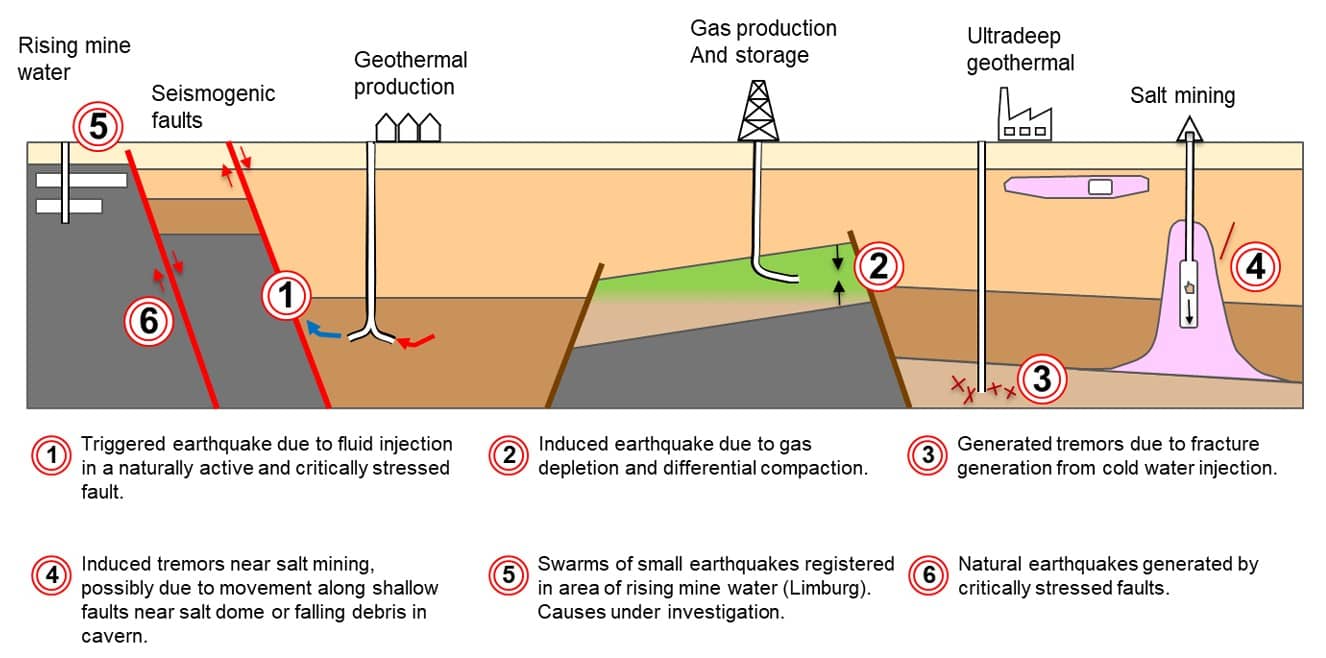
Image: © KEM / TNO
Schematic figure of potential seismicity effects of mining